Artist Research: Lera Efremova: Future

Artist Research: Lera Efremova: Future

I wanted to find an illustrator that worked with pleasing colours and textures. Although this isn’t related to the future of the body directly, I like the way Efremova uses colours and space in her work.

In terms of context, her work is sold as high quality digital files, cards, posters etc. So, visually pleasing illustrations to be placed in the home.

I was thinking I could apply it to my work in terms of experimenting with different media in my sketchbook. I want to focus on generating textures so I can have a base collection of bright colours and techniques to use as backgrounds in illustrative work.
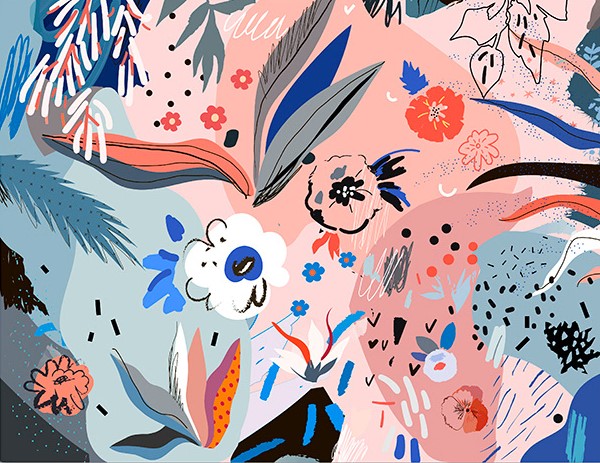
I want to take direct inspiration from the kind of shapes and colours she uses. E.g. the collections of stippling-esque dots, or the leaf with a dot grid on the far left that’s been roughly cut.
I like the busy collections of objects and shapes against the dark, basic background. The colour scheme is mostly desaturated blues, with a few very light blues and pinks as a complimentary highlight colour. Efremova works a lot with pale pink and blue, but that combination is very trendy at the moment.

I made some textures and experimented while looking at her work. You can tell from the colours and some of the shapes. I also just wanted to suspend judgement and try out whatever I could in case something cool happened.
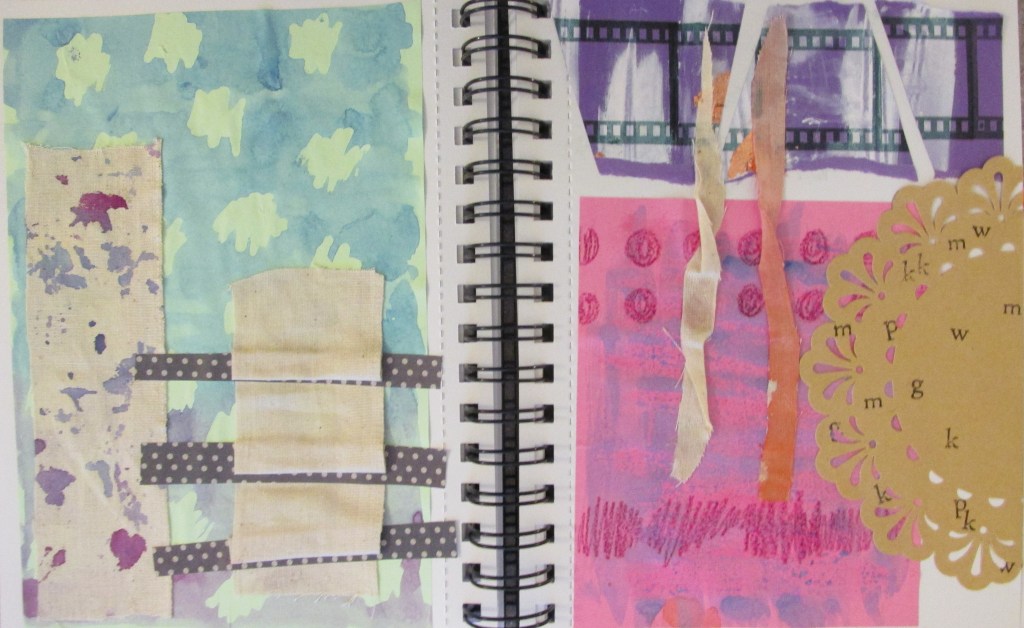
I like the brown doily with lettering stamped onto it. I also really like the blue and purple spattered calico fabric.
The blue and pink posca pens were more successful than I’d hoped.
Textiles Retrospective

Textiles Retrospective

The aim of the workshop was to take inspiration from architecture to create our own textiles. Examples of architects we took inspiration from included Zaha Hadid, Frank Gehry and Santiago Calatrava.

The morning focused on creating samples of textiles and learning basic techniques.

This is a zigzag pencil pleated fabric. It is created by folding two sheets of paper into this shape and sandwiching fabric between as a type of mould. Applying heat sets the fabric to the same shape.
This is the process to create a box pleat. We offset the other side’s pleats to create a twisted box pleat. The final result can be seen in the photo of my completed work.
This is a twisted pencil pleat. The samples were finished that afternoon by sewing a straight line across the pins on a sewing machine.
I created this myself. I quite like how organic it is; it reminds me of a beehive or maybe holes that decay causes in wood.
The finished work.

In terms of what I enjoyed or found useful, being taught how to use the department’s sewing machines will be invaluable. Since I enjoy embroidery, I could use the sewing machine to create bags or pockets from the material I embroider on – or to work on garments that already exist, like shirts.

The day of the workshop, I was in a very bad headspace. My heart wasn’t entirely in the second half of the day, so I could have made more of the time I was given.

In taking this further, I will probably focus on applied textiles rather than constructed textiles. It resonates more closely with my illustration-based art.