I’ve been reading Type & Typography by Phil Baines and Andrew Haslam for about a week now. It’s dense, but already I think it’s changing the way I look at typography.
I can’t remember or make notes on everything I’ve read, so I’ll just include a couple of highlights (if anything to prove I’ve actually read the book!).
“Lexicographers record these patterns of change, continually collecting words, cataloguing them and preserving them in dictionaries, glossaries and thesauruses.”
“If writing were architecture, then books would be buildings, pages floors, paragraphs rooms, sentences walls, words furniture, letterforms bricks, phonemes clay and grammar mortar.”
In reference to Grammar
I learned that the origin of the idiom “a square meal” is actually from the Navy, where for some reason they had square plates.
I also learned that the Phoenicians were one of the very first cultures to create an alphabet, and that theirs had 22 letters. E.g. “Aleph”, meaning Ox, was similar to a small pictogram of a bull with horns.
The Greeks took many of the Phoenicians’ letters and changed them to suit their own culture. Aleph was flipped so the “horns” of the ox faced downwards, and was renamed “Alpha” – or, of course, “A”. It really interested me that the evolution of language is that traceable!
I’ve learned about the evolution of printing from its very origin in the fifteenth Century when the fist type was printed. I’ve also learned of many examples where the circumstances dictate the style and source of certain typefaces. For example, “Broken Script” or Textura (you might know it as Gothic), was amongst the first typefaces to be printed but in order to be accepted as an invention it closely mimicked handwriting at the time.
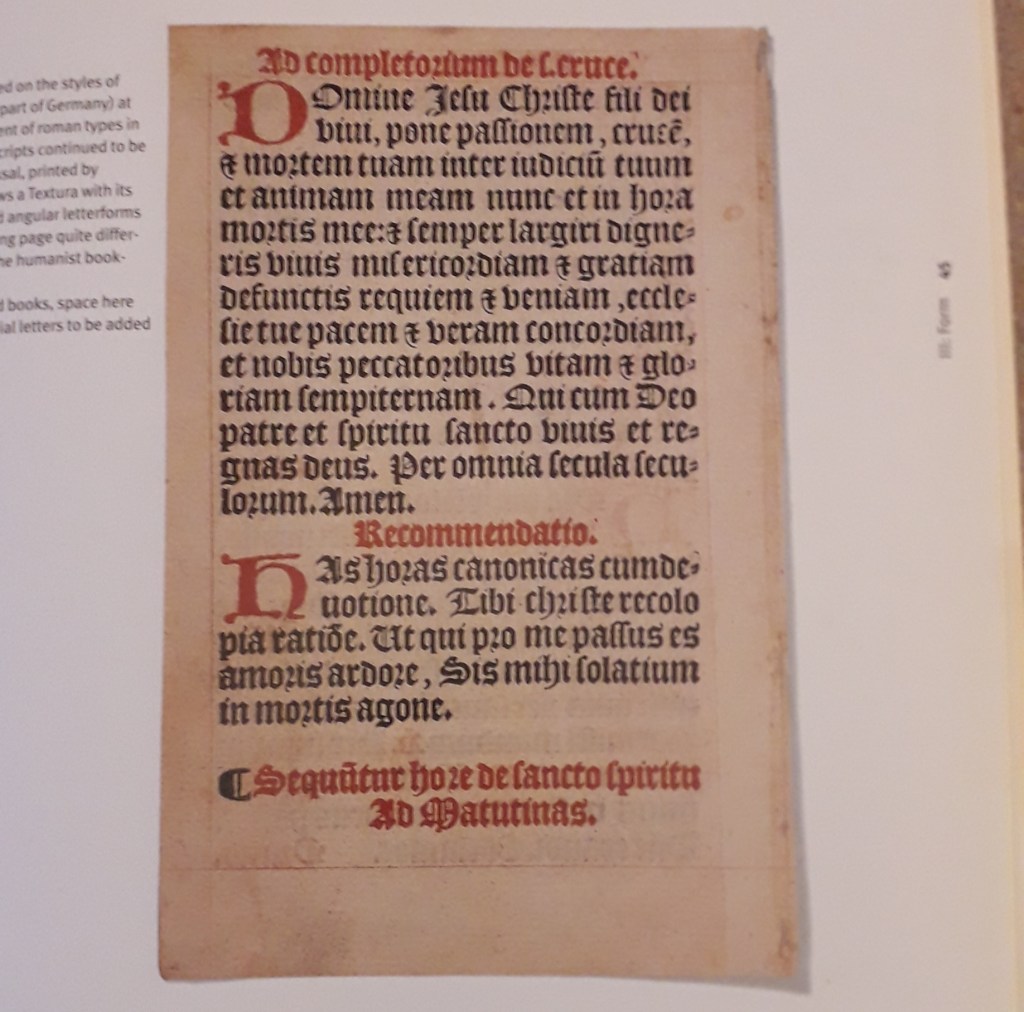
Many typefaces, in fact, mimic handwriting either implicitly or explicitly. E.g. Copperplate fonts mimic brushstrokes made by a calligrapher’s pen.
The move from metal cut letterpress printing and typesetting to Phototypesetters was revolutionary, and then again to typewriters. Each new invention speeds up – and reduces the cost of – reproducing type for mass production.


